Located among pristine woodlands in the Ryerson historic home in Riverwoods, Il., Brushwood Center at Ryerson Woods promotes the importance of nature for nurturing personal and community wellbeing, cultivating creativity, and inspiring learning.
Author: Megan Donahue
A Joyful Black History Month Celebration at Brushwood Center
On February 22, 2026 the community gathered at Brushwood Center for a beautiful and inspiring Black History Month event.
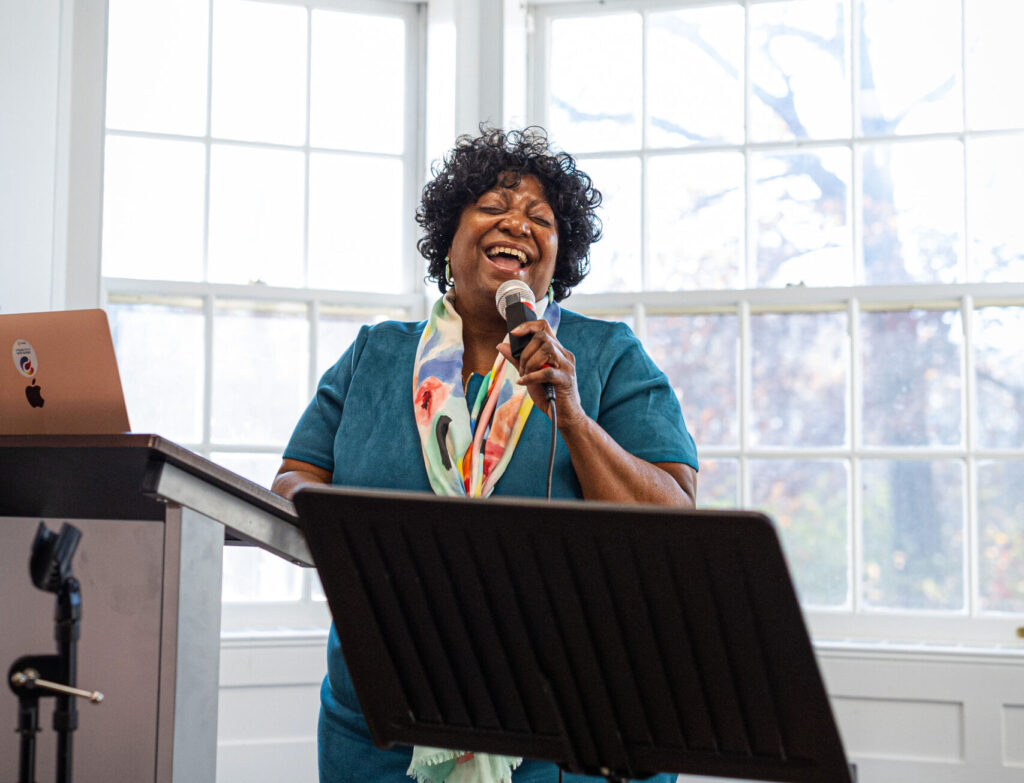
Joyful! A Celebration of Black History Month, is a concert curated by singer Angela Walker, accompanied by a culinary experience by chef Jeffrey Williams.
“Let Out Your Joy”
The program of musical selections by Angela, Patrick A. Pearson, and Tranelle Duffie traced the history of the African American experience and reflected on the role of music in the community. The audience clapped, sang, and cheered as Angela, Patrick, and Tranelle guided them through spirituals and gospel songs, from enslavement to the Civil Rights Movement to the modern day.
“The music was wonderful and the spirit was beautiful,” said one audience member.
Angela M. Walker is a U.S. Navy Veteran, musician, motivational speaker, community navigator, and Veterans’ advocate. She holds a master’s degree in Education and Inner City Studies from Northeastern Illinois University. She has taught at the City Colleges of Chicago and worked as a Veterans Service Officer Representative for the State of Illinois, as well as a marketing consultant and health navigator. She is the founder of The Brave Project.
In addition to her advocacy, Angela offers calming presence and grief support in hospice and hospital settings and promotes expressive therapy and positive psychology through her presentations. She performs as a songstress year-round for local and national Veteran service organizations, civic groups, and private events.
Angela says,”I think when you immerse yourself in the arts, you just lose yourself a little bit, but it also gives you time to meditate and think about the things that are important to you and to think about those inner dreams that need to come out… I’m able to express myself. And when you express yourself, you can let out your pain. You can let out your questions, you can let out your joy. It comes out and you share it with others. And then in turn, the audience shares their joy with you. And I can see that when I’m performing, I can see when people are being receptive to the music and the songs.”
“This Food is Love”
In the kitchen, Jeffrey Williams of From Hood to Table presented a hands-on demonstration about significant foods in African American culture, explaining the culinary history as well as the recipes. With a little help from participants, he prepared fried chicken, macaroni and cheese, greens with smoked meat, cornbread dressing, and cornbread.
Jeffery is a Chicago-raised private chef, and Waukegan urban farming and sustainability teacher focused on solving the food crisis throughout urban landscapes. After six years of supporting and coaching high school students, he found peace and a safe space in his backyard during the pandemic. He connected his passions for cooking and gardening and founded From Hood To Table. He aims to prioritize access to the best and freshest food by teaching communities how to grow and use what they have to make compost and organic inputs. He intends to build a bridge to the past and connect Black and Brown communities to a more sustainable and flourishing lifestyle.
Thank you to Angela, Patrick, Tranelle, and Jeffrey for creating such a special day at Brushwood!
inside Brushwood
The Work is Love: Showing Love to Our Community Programs Team
By Ashley Cullen-Williams
I have to admit something—teamwork hasn’t always been my thing. In the past, I didn’t have strong teams around me. I didn’t experience collaboration as something life-giving. If I’m honest, I resisted it. I thought it slowed things down. I thought it made things messy. I thought it required more energy than it returned.
Then I came to Brushwood.
And something changed.
Walking the trails, watching the trees through the seasons, has changed how I understand connection.
A forest does not rush its becoming. It honors cycles.
There is a season for planting, a season for growth, a season for shedding, and a season for stillness. Still beneath every visible change, the roots remain intertwined. Nutrients are shared. Protection is offered. The system sustains itself because it is connected.
No tree thrives alone.
That is what I’ve witnessed in our Community Programs staff.
Like winter roots below frozen ground, much of their work happens unseen—planning, adapting, checking in, preparing, supporting one another when the days feel long. In spring, their ideas bloom into programs that welcome young people and families to explore creativity. In summer, they hold space for growth and joy outdoors. In fall, they harvest lessons learned and plant seeds for what’s next.
There is a rhythm to it.
A trust in the process.
A willingness to show up for each season without ego.
And this feels like Brushwood’s season.
A season to anchor in our mission.
A season to intervene when the community needs call us forward.
A season to convene partners and neighbors around a mutual purpose.
A season to model what healing, justice, and environmental connection can look like in practice.
A season to support—steadily, consistently, with care.
Our Community Programs staff embody this season. They are rooted enough to anchor. Courageous enough to intervene. Open enough to convene. Clear enough to model. Steady enough to support.
They have changed my understanding of teamwork. Healthy collaboration does not drain you—it fortifies you. It makes you more resilient in harsh climates. It assures that when one branch bends, the forest still stands.
This February, as we talk about love, I’m thinking about love as commitment. Love as consistency. Love as collective flourishing.
To our Community Programs staff: Abbey, Jess K, Jess R, and Eddie, thank you for being interconnected. Thank you for capturing our story; committing to people; creating transformative experiences; and always being curious with care!
Thank you for tending the soil even when no one is watching.
Thank you for helping this community not only survive its seasons but flourish through them.
As bell hooks reminds us, “Love is an action, never simply a feeling.”
And your work is love in action.
When the Land Speaks on the World’s Biggest Stage: Super Bowl Reflections
By Ashley Cullen-Williams
Bad Bunny’s Super Bowl halftime performance wasn’t just a musical moment — it was a reminder that land holds memory.
The imagery of sugarcane fields immediately evoked the Caribbean’s colonial past. Sugar cane is not a neutral crop. It represents forced labor, extraction, and economies built through enslavement and exploitation. By centering this landscape on one of the world’s biggest stages, Bad Bunny invited viewers to sit with the reality that culture and wealth are often rooted in histories of land and labor.
One of the most striking choices was that the “plants” on the field weren’t props at all — they were people. Human bodies became the landscape. What could have been a limitation turned into a powerful metaphor: the land has always been shaped, worked, and sustained by people. Nature is not separate from humanity — it is inseparable from it.
Layered into the performance were visible power lines and infrastructure — subtle, but intentional. The grid represents modern dependence, extraction, and control: who gets power, who loses it, and whose land is sacrificed to sustain systems far away. These lines cut through natural landscapes just as colonial and industrial systems have long disrupted Indigenous and island ecosystems.
Together, the sugar cane, the people-as-land, and the power grid told a fuller story. Land is farmed. People are used. Energy is extracted. And yet — culture survives. Community persists. Joy and resistance still take up space.
At Brushwood, we understand land as a teacher. This performance echoed that truth. When people are treated as props, the land suffers. When land is overexploited, people suffer too. Healing — ecological, cultural, and communal — begins when we remember that people, land, and power are deeply connected.
Meet Jerry Loza
Jerry Loza is an artist who served four years in the Marines after attending Whitney Young High School in Chicago. After his military service, Jerry returned to the Chicago area. He says, “I’m a firm believer in the healing nature of art. I love teaching digital art to help pass along this coping skill.”
You may recognize Jerry’s work from At Ease in Nature, Brushwood’s annual art exhibition featuring Veteran and military community artists, where he has exhibited several times. Jerry also displays his work around the community at galleries and art fairs.
See Jerry’s art on display at Brushwood Center at Ryerson Woods February 1 – 28, 2026.
Through the Fire, by Jerry Loza Media: Digital
Jerry’s Artist Statement
“I always was a pencil and pen artist but stopped many years ago. I started drawing digitally in 2018, but during the COVID lock down I was completing a drawing a week. I’m involved in multiple Veteran art groups. My primary muse is my city, Chicago, but I’ve also tapped into my heritage and my military background for inspiration.”
Image: Jerry Loza pictured with his work at an art fair.
Artist of the Month Events
February 28 10:00 am – 3:00 pm | Free Open Art Workshop with Jerry Loza
Open Art Workshop is open to anyone who wants to make something in any area of visual arts and crafts, from the experienced artist looking for a community of others to work with, to the complete novice who just wants to try something out in a low pressure environment, or the family looking for a fun kids’ activity to fill their afternoon – this workshop is for you!
Image: Buckingham Fountain by Jerry Loza Media: Digital
a forest bathing invitation
Embrace Winter
By Jess Rodriguez
Jess Rodriguez is the Coalition Building Manager at Brushwood Center, and a certified forest bathing guide through the Association of Nature and Forest Bathing.
Forest bathing is an opportunity to remember our intrinsic connection to nature. Inspired by the Japanese practice of Shinrin-Yoku, forest bathing is a guided experience that works to mend the relationships humans have with themselves, the concept of time, their communities, and with the more than human world. It is a practice focused on remembering reciprocity.
To help you embrace winter and connect with nature, we offer this forest bathing invitation this season. You can experiment with this invitation wherever you are, but we especially welcome you to try it at Brushwood Center at Ryerson Woods.
Take 10-15 minutes to wander out into winter.
As you wander, take a moment to settle into the present by slowly turning to your senses.
What does winter sound like?
What does winter feel like on the parts of your body that are exposed?
How does the air of winter feel within your nostrils as you breathe in deeply?
Does the air feel different on your tongue if you breathe in deeply through your mouth?
As you settle in, what would it be like to notice what winter looks like?
What different signs of life might you notice persisting through winter?
What signs of life might you add to winter?
Take your time to move at a pace that is slower than usual and notice all that winter might have to offer.
Meet Polly Greathouse
Polly Greathouse is a multidisciplinary artist whose work explores the vitality and interconnectedness of the natural world.
Trained in painting, drawing, and photography at the University of Illinois, she began her career in animation and interface design, helping pioneer early mobile user interfaces before returning to fine art. Her paintings in oil on paper, inks, multimedia, and water media combine fluid, watercolor-like transparencies with bold, gestural strokes and layered impasto.
Polly also integrates photography and digital tools into her practice, expanding her painterly vocabulary. Influenced by Sumi-e techniques and abstract expressionism, her compositions evoke ecosystems in motion—shaped by shifting light, weather, and seasonal cycles. Rather than a single focal point, her work offers immersive landscapes that mirror the experience of being in nature, where everything is alive and interconnected.
See Polly’s art on display at Brushwood Center at Ryerson Woods January 3 – 31, 2026.
Aerie Lounge, Fenway Victory Gardens, by Polly Greathouse Media: Oil on paper
Polly’s Artist Statement
“I paint natural environments from various regions, but most often observe, honor, and celebrate the landscapes of Illinois where I live and work. My art reflects the expressive, ever-changing motions of ecosystems. A consistent element in my work is the absence of a single focal point—much like the experience of being in nature, where wind, sunlight, water, and terrain shift dynamically. I aim to capture fleeting impressions: the posture of a plant, the motion of a bird, the awesome presence of wind or light. These glimpses seed a memory of the moment—one I’m grateful to witness, breathe in, and translate through artistic impressions.”
Image: Twelve Pots, Fenway Victory Gardens, by Polly Greathouse Media: Oil on paper
Artist of the Month Events
January 31 10:00 am – 3:00 pm | Free Open Art Workshop with Polly Greathouse
Open Art Workshop is open to anyone who wants to make something in any area of visual arts and crafts, from the experienced artist looking for a community of others to work with, to the complete novice who just wants to try something out in a low pressure environment, or the family looking for a fun kids’ activity to fill their afternoon – this workshop is for you!
Image: Red-wing blackbirds, Independence Grove by Polly Greathouse Media: Charcoal sketch
The Brushwood Top 10: 2025
By Catherine Game
2025 was a big year for Brushwood Center!
Looking back, it’s hard to narrow down our most significant moments, as there are so many thanks to the Brushwood team, our community, and our supporters. The Brushwood Top 10 is an annual tradition that we are always happy to share, so the whole staff came together to choose the following incredible moments of 2025.
Thanks to our supporters for making these moments at Brushwood possible. We can’t wait to make more moments of impact with you in 2026!
1. Celestial Forest Bathing
Abbey Castro, Communications Coordinator
Brushwood partnered with Reciprocal Forest Bathing to provide free opportunities throughout the year for the community to mindfully connect with nature, in English and Spanish.
Jess Rodriguez, Coalition Building Manager and Forest Therapy Guide, leads a Forest Bathing session.
2. Celebrating the 42nd Annual Smith Nature Symposium Youth EnvironmentalLeadership Awardees
Ashley Cullen-Williams, Senior Program Director
This year, we were thrilled to honor Robin Wall Kimmerer at the Smith Nature Symposium Awards. We celebrated the work of future environmental justice leaders, Ja’Harmony Johnson and Victor Hinojosa, two exemplary young leaders.
Youth Environmental Leadership Awardees Victor and Ja’Harmony with Robin Wall Kimmerer at Chicago Botanic Garden
3. The Community Leadership Roundtable: In the Field
Angela Ramirez, Administrative Coordinator
This year, the Community Leadership Roundtable took a new form: Environmental Justice and Healing bus tours to some of the most relevant sites in Waukegan. Watch the short film by Videographer-in-Residence, Kateryna Sazonova.
The morning bus tour group of Brushwood partners, Board members, and participants at Yeomen Creek Landfill.
4. The At Ease in Nature Exhibition
Jes Klinge, Veteran Programs Specialist
The November art exhibition, At Ease in Nature featured artwork created during our 2025At Ease programs, as well as work inspired by experiences in nature from members of the Military Community. This year’s exhibition highlighted the diversity that can be found in nature and in the armed forces, making each stronger than they would be without it.
Dante Plata, Army Veteran, with his photography pieces at the At Ease in Nature opening.
5. Expansion of the TIERRA Program
Jess Rodriguez, Building Coalition Manager
TIERRA (Transforming Internal Experiences for Resilience and Restoration through Acceptance) is a first-of-its-kind, nature-based mental health intervention. This year, it expanded beyond its pilot phase to new organizations in Lake County, and 17 new Community Health Workers were certified in the program.
The Accelerator team celebrating with the certified promotoras group.
6. Before Dreams Are The Last Place We Find You: Lydia Cheshewalla
Julia Kemerer, Director of Arts and Administration
Brushwood welcomed Osage ephemeral artist Lydia Cheshewalla for a solo exhibition of the work created during her residency at the Center for Humans & Nature.
Lydia Cheshewalla gives an artist talk on her collaborative process with nature during the exhibition opening.
7. The Hunter Family Foundation gift to name The Maxine M. Hunter Performance Plaza
Mirja Spooner Haffner, Director of Development
In April, Brushwood received a transformative gift of $2.5 million from the Hunter Family Foundation to create The Maxine M. Hunter Performance Plaza, in support of Brushwood Center’s comprehensive campaign to expand programs and renovate our building at Ryerson Woods,Activate: A Campaign for Investment in Community.
Rendering of the future Maxine M. Hunter Performance Plaza by Serena Sturm Architects.
8. The Release of Flourish
Parker Nelson, Director of Public Programs and Music
This fall, Ensemble-in-Residence Black Moon Trio released a new album with Brushwood called Flourish, featuring our 2025 Smith Nature Symposium Honoree, Robin Wall Kimmerer.
Parker Nelson with Trisha Steele from Prairie Circle Unitarian Universalist Congregation receiving a copy of the Flourish album.
9. Supporting Youth and Families withNEST Packs
Eddie Flores, Youth Education Coordinator
Created in response to families’ fear of going outside due to ICE activity, Brushwood’s NEST Packs are designed to nurture connection, curiosity, and community by providing families with Nature Exploring Safety Tools backpacks that make outdoor exploration both accessible and affirming.
Staff members Abbey Castro, Jes Klinge, Eddie Flores, and Ashley Cullen – Williams pack NEST packs at Brushwood.
10. Growing the Team
Catherine Game, Executive Director
Brushwood Center welcomed Ashley Cullen-Williams as our new Senior Program Director this summer. Ashley is a passionate and licensed mental health advocate and social-emotional learning expert, and has already had transformative impact in her new role at Brushwood. Learn more about Ashley’s story through her video.
Ashley Cullen-Williams confers with the Community Programs Team
And I have a bonus top moment, as I grew the “team” in an additional way. My family and I welcomed baby Emerald, born on Earth Day of this year!
Emerald has already enjoyed touring Brushwood exhibitions and perusing the Nature-Inspired Holiday Market, and she can’t wait for ¡Hola! Wiggleworms!
We wish you the best in 2026!
REFLECTION BY BRUSHWOOD SENIOR PROGRAM DIRECTOR
Lake County Community Convening
By Ashley Cullen-Williams
The Lake County Community Foundation Cross-Sector Coordinated Calls bring together partners from across Lake County — nonprofits, local governments, health systems, schools, and community leaders — to share real-time updates, resources, and strategies that support community safety and stability during moments of heightened risk and ICE raids.
These calls are flexible and open to all. Participants can join as capacity allows people to share information, access support, or simply stay informed. The space serves as a central hub for accurate information, communication, and regional strategy, helping ensure that our community stays connected and coordinated.
I have opened and closed each session with a grounding moment and brief reflection that connects our present challenges to lessons and strengths from the past. This practice helps root the call in healing, dignity, and shared purpose.
At the heart of this effort is a commitment to protecting the safety, dignity, and stability of all Lake County residents — physically, emotionally, and economically — especially in times of uncertainty or danger.
Here are my October welcome remarks:
The First Welcome shared on October 23, 2025
Good morning everyone —
To our nonprofit leaders, our government partners, our educators, and every community member here — welcome.
Your presence today means something. It means that even in times of fear, you chose connection. Even in times of division, you chose community.And even when our people are being targeted, detained, and displaced — you chose courage.
Because right now, we are living in a season of fear. ICE raids. Deportations. Families separated in the middle of the night. Children are growing up afraid to call this land home.
But for many of us grounded in the Black experience — we’ve known this kind of terror before. We know what it means to have your existence criminalized, your family torn apart, and your humanity questioned. And yet, our ancestors showed us that fear can never silence a people rooted in love and liberation.
In the 1960s, young organizers created the Student Nonviolent Coordinating Committee — SNCC.
They weren’t just marching — they were teaching. They trained local people to register voters, taught strategy, and built “freedom schools” where political education became the pathway to power.
Lesson one: When we understand how power works, we learn how to change it. Education is the first act of freedom.Then came the Black Panther Party. They didn’t wait for systems to save them — they created what their people needed. Free breakfast programs. Community health clinics. Legal aid. They turned compassion into infrastructure.
Lesson two: Liberation isn’t charity — it’s self-determination. When systems fail, we build what we need with dignity and love. And both movements — SNCC and the Panthers — built coalitions. They worked alongside Latino, Indigenous, Asian, and poor white organizers because they understood — no one is free until everyone is free.
Lesson three: Solidarity is our greatest protection. Fear isolates; community liberates.
Those lessons still live here — in our work, in our neighborhoods, and in this very room.
Educate for Liberation.
Create spaces where people can learn their rights, study systems, and imagine new ones. Political education must be part of every program.
Build What We Need.
Food security, healing spaces, youth employment, housing — when we build for ourselves, we move from survival to sovereignty.
Heal as We Organize.
The revolution must include rest, art, therapy, and joy — because collective care is a form of resistance.
Protect and Empower Our Youth.
Just as SNCC trusted young voices, we must let our youth lead — not someday, but today.
Build Real Power Together.
Nonprofits, government, and community — we must share power, not just tables. Collaboration means shared accountability, shared vision, and shared humanity.
So today, we gather not in despair — but in defiance of it. We come from people who were watched and followed — but never broken. We come from movements that fed children when the state would not. We come from organizers who risked everything to make freedom a living word. If the Black Panthers could build clinics when hospitals refused us, if SNCC could teach democracy under threat,then surely we can build belonging in the face of ICE and injustice.
Because fear is how systems control us. But community — real, organized, loving community — that’s how we win.
So welcome, family.
Welcome to a gathering of courage. Welcome to the continuation of a long, sacred struggle. And welcome to the work of building the beloved community — one act of truth, one table of unity, one generation of freedom at a time.
Let’s get to work.
Art and Nature programming for the fastest-growing Veteran Demographic
Finding Her Voice: Brushwood’s Programs for Women Veterans
By Megan Donahue, with Angela Walker
Angela Walker knows Brushwood’s At Ease program like the back of her hand—Brushwood Center is not just a place for her, it’s her passion. But even leaders like Angela can be caught off guard, and that’s exactly what happened during a Nature, Art, and Wellness Day for Women Veterans.
These special events at Brushwood are a chance for women Veterans and their families to relax, recharge, and enjoy the serene beauty of Ryerson Woods. The day is packed with calming activities like yoga, forest bathing, and creative art workshops. But when Angela sat down for a writing exercise that day, she wasn’t thrilled.
“Write about my feelings? Nope,” Angela said. “We can paint, we can do yoga, we can even sing—but write about what happened in the military? Hard pass.”
She planned just to sit there quietly and let the others write. But something shifted.
“I ended up writing so much, I shocked myself!” Angela said. “It was like my voice came pouring out— I didn’t even know I had so much to say that was bottled up inside me. All it took was the right question and the right space. I started writing, and I didn’t want to stop. I’m still writing today!”
The Fastest-Growing Veteran Demographic
Women Veterans are the fastest-growing group of Veterans. Between the 2020 and 2023 fiscal years, the percentage of women Veterans increased from 6.3% to 11.3%. There are 2.1 million women Veterans in the United States.
Jes Klinge, an Army Reservist and Brushwood’s Veteran Programs Specialist, joined the military at the age of 17. With over two decades of service, she brings a depth of knowledge about military culture to her work at Brushwood. Since her arrival to Brushwood in 2020, the At Ease initiative has expanded significantly, especially offerings for women Veterans.
Jes is quick to avoid painting with a broad brush. “I think Veterans are like everybody else. Everybody really needs different ways to cope with mental health,” she says. Still, she notes, women Veterans do often have some things in common.
Feeling overlooked in the Veterans space is common, as is dealing with Military Sexual Trauma (MST). “Military Sexual Trauma is a really big problem in the women Veterans space,” Jes says. “I feel like a lot of these issues aren’t really talked about as much.”
U.S. Army Veteran and artist Ramona Pozek agrees. “I think that whenever people are coming up with programs, or if they want to do something for Veterans, they’re always thinking about the guys,” she says. She recalls people in the past assuming her male partner was the Veteran in the relationship, when she’s the one who served, and receiving care packages that were clearly intended for male service members.
“We love our country, and we are really proud of serving. We’re not looking for a whole lot. [But] if you’ve got something for the guys, then have something for us, too,” she says.
Research demonstrates that women Veterans face unique challenges throughout their service, and especially upon transitioning from the military into civilian life. The Military Times reported in 2019 that women Veterans report difficulties with feeling invisible when leaving the service, and face a lack of peer support, feeling unaccepted by civilian women, and struggling to find supportive peer groups.
The Wounded Warrior Project has found that women warriors experience MST, anxiety, and depression at higher rates than male warriors. 80% of women warriors scored as lonely based on the UCLA Three-Item Loneliness Scale. 61% of women warriors experienced symptoms of anxiety.
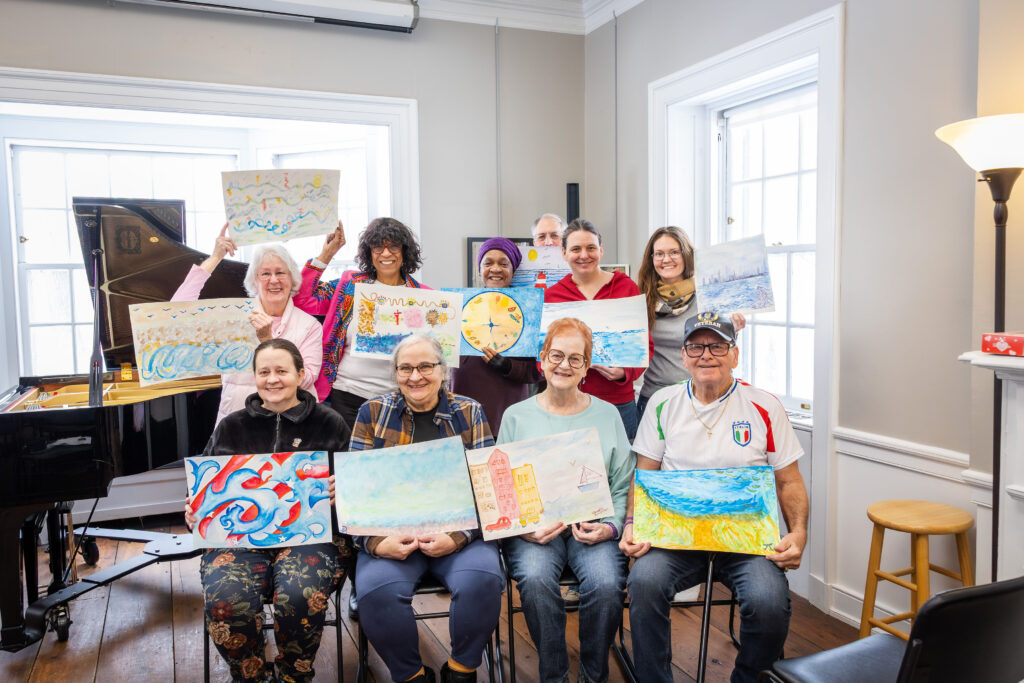
These unique challenges have led At Ease to develop specific programs for women Veterans. Each month, women Veterans meet online for a watercolor painting class, and an art social hour, an opportunity to work independently on art projects and build camaraderie with other women Veterans. Nature, Art, and Wellness Days are becoming a highlight for this growing Brushwood community.
Dedicated women’s programming lines up with anecdotal findings from the Wounded Warrior Project, which found that outcomes were more successful and women Veterans felt more supported when they were able to connect with advocates or organizations.
That’s certainly been Angela’s experience.
From Darkness to Creativity
Angela’s journey with Brushwood began at a tough time in her life. She had been discharged from the Navy due to medical reasons, leaving behind her dream of a long military career. Health challenges, along with depression and PTSD, made life feel heavy.
To make matters worse, Angela, a professional singer, lost her voice for a time due to her health issues.“Losing my ability to sing was devastating. Singing had always been my outlet, and I didn’t know if I’d ever get it back.”
When her voice returned, Angela eventually began volunteering, singing to patients at the VA hospital and taking part in an art therapy program. Her involvement led her to Brushwood, where she performed at a 2015 awards dinner honoring Robert and Sibylle Szaggars Redford. From that moment, she was “hooked on Brushwood.”
“What pulled me out of that dark space was my faith in God and Brushwood,” Angela said. “The people at Brushwood cared about me. They cared about Veterans. And they invited me to use my voice to help figure out how to support others like me.”
A version of this article originally appeared in Thrive, Brushwood Center’s seasonal print newsletter.
The Arts and Nature: Bringing Joy, Supporting Mental Health
By Megan Donahue
Picture a wash of blue watercolor paint spreading across a piece of thick paper. Imagine dipping your brush into a lush green, and layering the transparent color on top of the blue. It’s a sunny day, and the wind blows gently through the trees around you as you sit outside with your easel. You don’t have a goal, or any time pressure, or any assignment to make it “good” or “artistic.” It’s just you, the sun, the air, and the paint, exploring the possibilities.
How would that feel? Relaxing? Calm? Exciting?
Spending time in nature and experiencing the arts can influence your mood, emotions, and mental state, having a big impact on your overall wellbeing. The arts and nature bring joy to our lives, and they’re strong positive influences on our mental health.
1 in 5 adults in the US will experience a mental health condition in any given year, with anxiety disorders being the most common, followed by substance use disorders, depressive disorders, and post-traumatic stress disorders.
Whether or not you experience mental illness, taking care of your mental health is important. Mental stress takes a toll on your physical health. Chronic stress is correlated with a myriad of negative physical outcomes, including digestive problems, heart disease, sleep issues, high blood pressure, and muscle tension.
Research continues to show that participating in the arts and spending time in nature can positively impact mental health. The time you spend outside, making, and/or viewing art is more than pleasant pass-time or distraction. It’s an important way to take care of your mental health.
Art is a Mental Health Asset
Making art, or even simply looking at it, can impact the brain. Increased levels of serotonin and more blood flow to the pleasure-associated part of the brain are just some of the mental health benefits of art. Art is one of the ways we find meaning in our lives, express and process emotion, and connect with each other.
Art has been a part of Jerry Loza’s life as long as he can remember. As a child, he had natural drawing talent and he continued to draw throughout his life. “Even in the Marines, I was making drawings for guys,” he says.
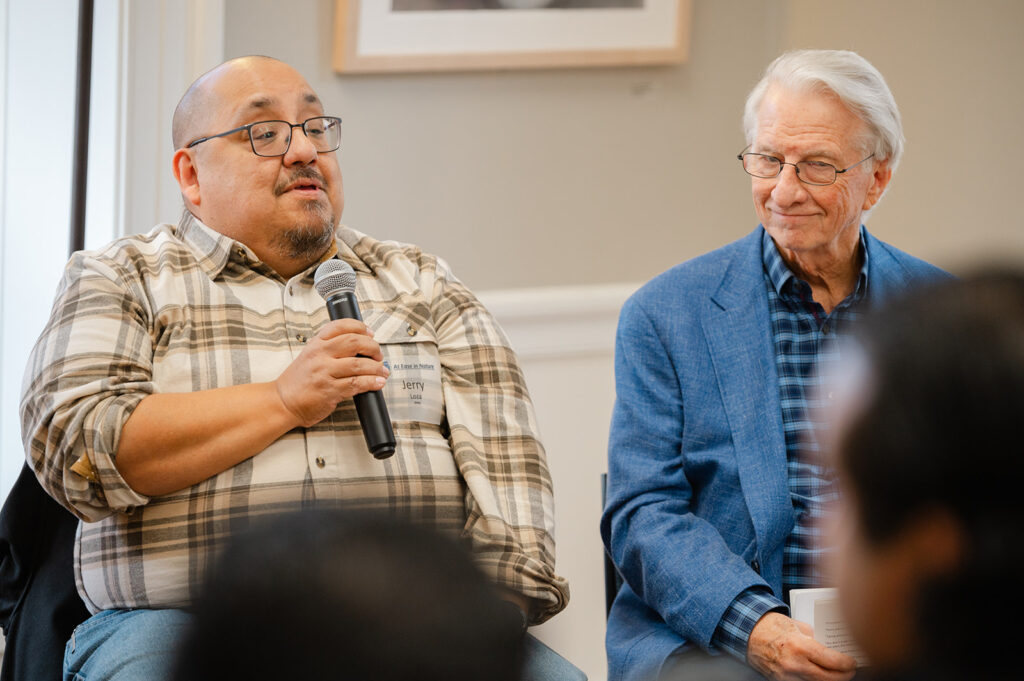
Veteran artists Jerry Loza and Michael Lewis on the At Ease in Nature opening reception panel, November 2025.
Drawing has become part of his mental wellness practice. “When I need to get away from reality, I can 100% focus on my drawing,” he says. A digital artist, he draws using an app on his phone, whenever he needs to decompress and manage stress. (You may recognize Jerry’s work from At Ease in Nature at Brushwood, where he’s exhibited his art with other Veterans and members of the Military community.)
Jerry served in the U.S. Marines from 1984-1988. “Joining the military was a hundred percent the right choice for me. It was a great experience,” he says. “But as life progressed, things got heavier and messier, and I wasn’t dealing with anything. I was just filing it all away…I did this for many, many, many years until it was coming apart at the seams.”
Jerry’s mental health was affecting his day-to-day life. “It was starting to trickle out,” he says. “I was getting short- tempered. I was getting irate. I was not my usual self, even when I was my usual self. It was a thin veneer. It was very obvious that it wasn’t the real me. I was just pretending.”
The breaking point came when Jerry’s boss directly asked him if he was okay. “And that was it. I shattered,” he says. “It was just the most embarrassing in a way, but the most enlightening thing that I’ve ever been through because right then and there I knew, okay, that’s it. I’m not okay.”
That conversation led to Jerry beginning a journey to improved mental health, which included talking to a therapist, and sharing about his experiences with friends and family.
Art is also part of the healing journey. “I met the Veteran Art Tribe. They are just a phenomenal group. I had no idea this was even a thing. We were able to communicate and talk about pain, and everything else, and dealing with it through art.”
Addressing his mental health has improved Jerry’s life tremendously, as a person and an artist. “There’s so much more to my drawings in the past year. I leveled up, absolutely leveled up. I went much more in depth. I put more of myself into the paintings, because I’ve learned a lot about myself in the past year. I’ve learned more about meditation and calming myself and about dealing with anxiety and helping others deal with anxiety. I’ve learned a lot about myself and most of it I’m pretty content with. I am back, I’m me again.”
Nature Nurtures
The evidence continues to mount: nature experience is associated with psychological wellbeing. Time spent in nature promotes positive social interactions, happiness and sense of wellbeing, improved memory and attention, and decreases mental distress. Nature experiences are also associated with a reduction of risk factors and burden of some types of mental illness.
Sunlight, fresh air, and other experiences in nature can make a real difference in how you feel. A 2016 study found that, “Natural elements and sunlight exposure related positively to job satisfaction and organizational commitment, and negatively to depressed mood and anxiety…Natural elements buffered the relationship between role stressors and job satisfaction, depressed mood, and anxiety.”
These mental health benefits are particularly important for young people, as mental health problems are dramatically on the rise in children and teenagers. Elisa Cisernos, Senior Therapist at Lake County Health Department & Community Health Center, Child and Adolescent Behavioral Services, has seen this in action by partnering with Brushwood Center’s It’s A. W.I.N. program for youth. “In therapy, we try to talk about the importance of nature and art, but there’s only so far talking can get you until we bring kids to actually experience those things and practice what we talk about in therapy,” she says, “That’s where the true magic and power is. Coming to Brushwood is one of few times where I actually see kids allow themselves to slow down with nature.”
Connect with Art and Nature
You don’t have to spend a lot of money or travel very far to get mental health benefits from making art or exploring nature. Sitting quietly on the lakeshore, taking a walk through the snow, playing an instrument, or coloring in a coloring book can get you started. When you think about taking care of your health, include your mind by giving yourself time outside and time with art.
This article originally appeared in Thrive, Brushwood Center’s print newsletter.