
Book Talk with Joel Greenberg
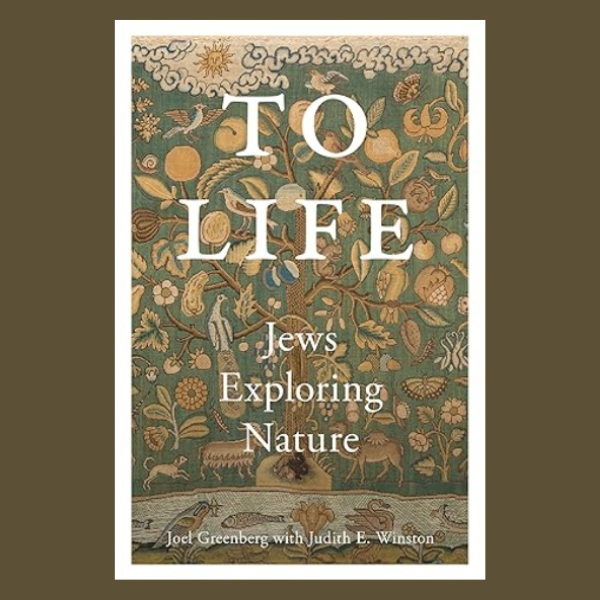
To Life: Jews Exploring Nature
By Megan Donahue
Brushwood Center is pleased to welcome friend, author, and former board member Joel Greenberg on August 1, 2026, to discuss his new book, To Life: Jews Exploring Nature.
“This work is quite personal, as it reflects my Jewish heritage at birth and persistent passion for the natural world acquired a few years later,” says Joel. “There have been books on Jewish mobsters, athletes, and art historians but few on those who studied the various facets of natural history. There have certainly been Jews who have done so in the past and in the current world there are many. But participation in natural history as a career or serious avocation was much less common.”
Joel has written several books on what he calls historical natural history, including Feathered River Across the Sky: The Passenger Pigeon’s Flight to Extinction, A Natural History of the Chicago Region, and Of Prairie, Woods, and Water. As he conducted his research, he found a striking lack of Jewish names.
The seeming absence of Jews in the world of natural history can be credited to many factors, from scriptural interpretation, medieval rabbinic scholarship, antisemitism in higher education, and patterns of settlement in America. Still, as you look closer at history, you’ll find that there were always Jewish people studying nature, even if not in great numbers.
“This project took 10 years,” Joel says. “It took a year or two just to put together a list of names of potential people.” In the end, he created eight chapter-long biographies of Jews who studied aspects of natural history.
“What I find really interesting are the people,” Joel says. His research brought him dramatic and interesting stories to tell about these fascinating characters, including:
- Philip Hershkovitz, who left the University of Michigan to explore Ecuador. “He wanted to go to the cheapest place he could in South America to study and collect neotropical mammals,” Joel explains. “He had no contacts. He did not know Spanish. He had almost no money, but he went.” Hershkovitz became a curator at the Field Museum, with an expertise in rodents.
- Libbie Hyman, who had graduated first in her high school class, and was working in a cereal factory putting stamps on boxes, when a former teacher pushed her to apply to the University of Chicago, where she was accepted. There, she studied botany, until an antisemitic lab manager forced her out of the program. She landed in zoology, where she became fascinated with invertebrates. Eventually, Hyman wrote a six-volume work on invertebrates, gaining worldwide recognition. When Joel visited Judith Winston, the premier authority on Libbie Hyman, she readily shared her research with him. Joel invited Winston to write the chapter.
- Nathan Leopold, who is perhaps best known for murdering 12-year-old Bobby Franks, in collusion with partner Richard Loeb. “He’s my one bad apple,” says Joel. Leopold’s contributions to ornithology are understandably overshadowed by his notorious crime and trial, but they are significant: as a young person, he was the first person to correlate the rarity of the Kirkland warbler with parasitism by brown-headed cowbird, arguably saving it from extinction; after his long prison sentence, he contributed to the knowledge of birds of Puerto Rico and the Virgin Islands.
In addition to the Jewish connection, Joel’s research found a significant Chicago thread uniting his subjects as well. “Of the eight people that I write about in detail, four have strong connections with Chicago,” he says.
Joel believes that learning about the Jewish naturalists of the past is relevant today. “Back in the day, there were fewer Jews involved in natural history than now. Now you might say it’s quite a few. However, there still are certain groups that are much better represented than others.” He points to a recent survey that showed that something like 85% of birders identify as non-Hispanic white. Diversity in natural spaces is still an issue.
In addition, he hopes these interesting biographies draw more people, Jewish and non-Jewish alike, deeper into the science and adventure of natural history. They’ve all made significant contributions to their fields,” he says of his subjects. He hopes that Jewish readers will learn more about a facet of Jewishness that they may not have been aware of. “And I think non-Jews would find the stories interesting,” he adds.
If you want to learn more about these interesting stories, don’t miss Joel’s book talk at Brushwood. Books will be available for purchase and signing.