Health, Equity, and Nature
Community Health Workers: Connecting Lake County to Better Health
By Megan Donahue
You thought the medical practice accepted your insurance. They don’t.
The clinic is open on Wednesdays and Fridays, but the provider who speaks your language is only there every other week.
You might qualify for Medicaid, but applying on the website is confusing.
Accessing healthcare can be a challenge for many people in America. Additional barriers like finances,
transportation, language, education, and cultural differences can make it even more difficult. Systemic
racism and the historic abuse of some communities by the medical system adds yet another layer of complexity when seeking care.
Tracey Smith of the Illinois Public Health Association (IPHA) saw the scale of the problem when she was working in healthcare in the early 2000’s. She noticed a major misalignment with complex patients, who were utilizing the emergency department often, but were missing out on other available resources.
The more she spoke with these patients, the more she realized that while they did need access to healthcare, “…they didn’t necessarily need what people were saying they needed, like another clinic on another corner closer to them. What they needed was help to get to those places, help to understand, help to be comfortable sitting in the doctor’s office, or finding a doctor that connected with them, and getting information to help providers provide the care needed.”
They needed a Community Health Worker.
What is a Community Health Worker?
The American Public Health Association defines a Community Health Worker (CHW) as: “a frontline public health worker who is a trusted member of and/or has an unusually close understanding of the community served. This trusting relationship enables the worker to serve as a liaison/link/intermediary between health/social services and the community to facilitate access to services and improve the quality and cultural competence of service delivery. A community health worker also builds individual and community capacity by increasing health knowledge and self-sufficiency through a range of activities, such as outreach, community education, informal counseling, social support, and advocacy.”
As Venoncia Bates-Ambrus, Executive Director of the Healthcare Foundation of Northern Lake County and a former CHW herself, explains, CHWs are different from other healthcare professionals. “As a community professional with expertise on community networks, community needs, community resources, challenges, barriers, and assets, they have all of that unique community-situated knowledge, or they develop it through the course of their work.” This expertise, and
the trusted role they hold within the community, makes it possible for the CHW to serve as liaison or ambassador,
connecting the community to healthcare.
While CHWs are most often found in healthcare and public health settings, a variety of organizations employ CHWs, including libraries, schools and more. Sometimes known as promotoras de salud, patient navigators, outreach workers, or peer health counselors, CHWs go by many titles, but all of them describe an important role in reducing health disparities.
What a Community Health Worker Does
The specific roles and responsibilities of a CHW vary depending on their community and organization, but Venoncia identifies two areas where CHWs are especially important: overcoming stigma and navigating access to
care.
“In certain cultures and communities, there may be a feeling of taboo,” she explains. “[CHWs] really help to address
barriers around accessing the healthcare because they address stigma, which can be associated with why people don’t actually ask for help or utilize resources when they’re available,” she says.
CHWs are also helpful partners in figuring out the available resources and explaining information.
“Organizations or sectors may have jargon, they may have different ways of communicating that aren’t always
understood by others outside of that sector,” says Venoncia. “So CHWs are uniquely situated to be able to transfer that knowledge back and forth between community and organizations.”
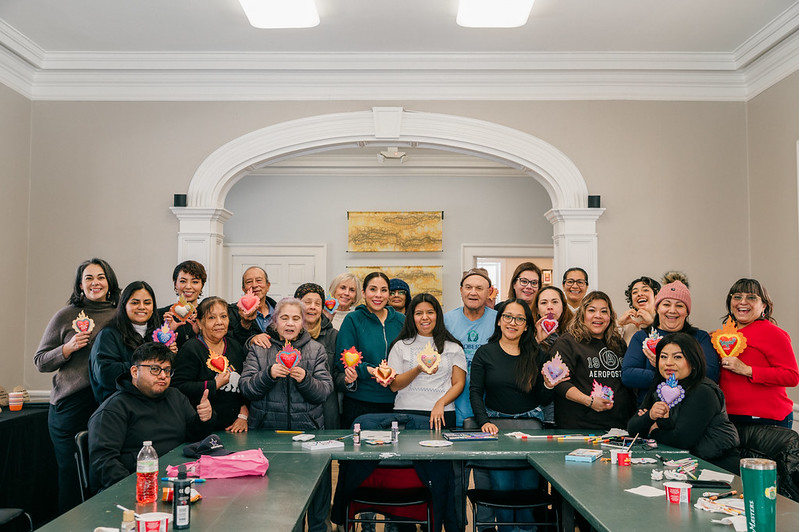
Andrea Barba is a Community Health Worker at Mano a Mano Family Resource Center in Round Lake. “What we
do is mainly education and outreach. We have a group of eleven promotoras, and we educate the community
with various health topics like cancer, diabetes, mental health. We mainly do preventative education,” she says.
The CHWs give presentations on health topics, and have a weekly live stream. “Every week we have a different guest to talk about a health topic or resource. We’re always trying to look for a way to reach as many people as we can to provide education and empower them.”
The community is an important part of Andrea’s life. “I’m an immigrant myself. When I saw Mano a Mano, I saw all the things that they were doing, and I always liked how the community, when I came here, embraced me. I really felt like I belonged to the community and I wanted to do something for them as well.” When she learned about the role of CHWs, it resonated with her.
“Something that came up a lot was being the bridge to fill the gap between the community, the people, and
the systems that don’t always include them. I wanted to do that to help people integrate and be a part of the
community.”
Next Steps for Community Health Workers in Illinois
Community Health Worker education and workforce development became the center of Tracey Smith’s career in public health. Once she learned about CHWs and saw the potential, she was committed to the model. “Many other countries have had community health workers at larger levels for a number of years, and we’d had it in the United States, but it would come and go in different decades and have different approaches, never well organized.”
She implemented a CHW program, then became very involved in Illinois Department of Public Health (IDPH) conversations about CHWs. Soon, she was connecting with other states that had CHWs, “it just kind of became a
snowball ripple after that,” she says.
Now, in her work at IPHA, Tracey is very focused on launching a state certification for CHWs, with a primary goal of enabling CHWs to bill Medicaid and Medicare in the state, potentially creating more stable funding for CHW work.
This work is necessary. As Tracey explains, “When we think about a continuum of health, I have different people I reach out to when I need some assistance. So many people don’t. But that’s where CHWs can fill so many spaces. They don’t have to be experts in the disease process, or anything else. It’s really about having someone to listen, to be able to connect, and when the route gets a little crooked or a little uncomfortable, being there to hold people up and to
continue down the process.”